Cartagena: Where colonial grandeur meets Caribbean soul

Explore the historic charm of Cartagena, the Americas’ premier Spanish colonial city. A JetBlue Vacations package makes it easy to experience everything Cartagena has to offer.

Cartagena: Where colonial grandeur meets Caribbean soul

Explore the historic charm of Cartagena, the Americas’ premier Spanish colonial city. From cobblestone streets to Caribbean island day trips, a JetBlue Vacations package makes it easy to experience everything Cartagena has to offer.

Just looking for flights?View flights only link opens in a new window

Cartagena overview

Cartagena de Indias is Colombia's jewel on the Caribbean coast - a UNESCO World Heritage city where 400-year-old stone walls enclose a labyrinth of plazas, colonial mansions, and boutique hotels painted in ochre, coral, and cobalt blue. Founded in 1533, it was one of the most important ports in the Spanish colonial empire, and the history is alive in every arch and cobblestone. Today, Cartagena draws travelers with a combination that's rare in Latin America: extraordinary architectural beauty, a vibrant and walkable urban core, a world-class dining and nightlife scene, and direct access - via short boat ride - to the turquoise waters and white-sand islands of the Rosario archipelago. It rewards everyone from history enthusiasts and architecture lovers to beach-seekers and food travelers, and it does so with a warmth and energy that's entirely its own.

Top reason to visit Cartagena:

  • A UNESCO Walled City unlike anywhere else in the Americas: Explore remarkably intact colonial fortifications, baroque churches, and flower-draped balconies. Walking these historic walls at sunset offers the most cinematic views in Latin American travel.
  • Getsemaní - a neighborhood with genuine soul: This vibrant barrio is the heart of Cartagena’s local culture. Visit Plaza de la Trinidad for world-class street art, authentic bars, and a spirited atmosphere that defines modern Colombia.
  • Caribbean island day trips that rival anything in the region: Take a 45-minute speedboat to the Rosario Islands or Playa Blanca for crystal-clear water and white sand. These stunning coral reefs are essential for any Caribbean vacation itinerary.
  • A dining scene that has caught the world's attention: Experience a fusion of African, Spanish, and Indigenous flavors. From gourmet tasting menus to iconic street-side arepas, Cartagena offers world-class dining at accessible prices.
  • Extraordinary nightlife in gorgeous settings: The city shines after dark with rooftop bars, salsa clubs, and candlelit courtyards. Enjoy sophisticated nightlife and outdoor dancing in Getsemaní and the Old City’s tropical climate.
  • History and culture far richer than any Caribbean beach destination: Cartagena has a layered story - the African diaspora, the Inquisition, the independence movement, Colombia's modern transformation. The museums, the Palace of the Inquisition, and Castillo San Felipe de Barajas make the beauty of the Walled City even more resonant.


Why book your Cartagena trip with JetBlue Vacations?

Exclusive savings and perks: With a JetBlue Vacations package, get the lowest JetBlue airfare, plus added savings when you bundle hotel, cruise or car. You’ll also enjoy perks like earlier boarding, a free inflight drink and more.

Customer support, 24/7: Our dedicated travel experts are available around the clock to assist with any questions or concerns before, during, or after your trip. Contact us, day or night, at 1-844-528-2229.

Secure payment options: We offer secure payment options like credit cards and debit cards. You can also choose a flexible plan that lets you pay a small deposit now and the rest closer to your trip.

Bundle your flights, hotel and more into one easy package and enjoy exclusive savings & perks.

checklistExclusive deals on top Cartagena hotels.

checklistThe lowest JetBlue airfare with your package.

checklistFlexible payment options to fit your budget.

checklistEarn TrueBlue points and tiles on qualifying spend.

Cartagena destination guide

Old City / Walled City (Ciudad Amurallada)

The UNESCO-listed Walled City is a near-perfect ensemble of Spanish colonial architecture - clock towers, baroque cathedrals, hidden plazas, and flower-draped balconies packed into a walkable historic core. The best boutique hotels in Cartagena are here, and the streets fill with energy well past midnight.

Best for: First-time visitors, architecture and history lovers, couples, boutique hotel seekers.

The Rosario Islands & Playa Barú (Day Trips)

A 45-minute speedboat ride from the city, the Rosario Islands are a national park with clear water and excellent coral reef snorkeling, while Playa Blanca on Barú is one of Colombia's most beautiful beaches. Most visitors do at least one day trip and wish they'd planned more.

Best for: Beach seekers, snorkelers, families, anyone adding a beach day to a city trip.

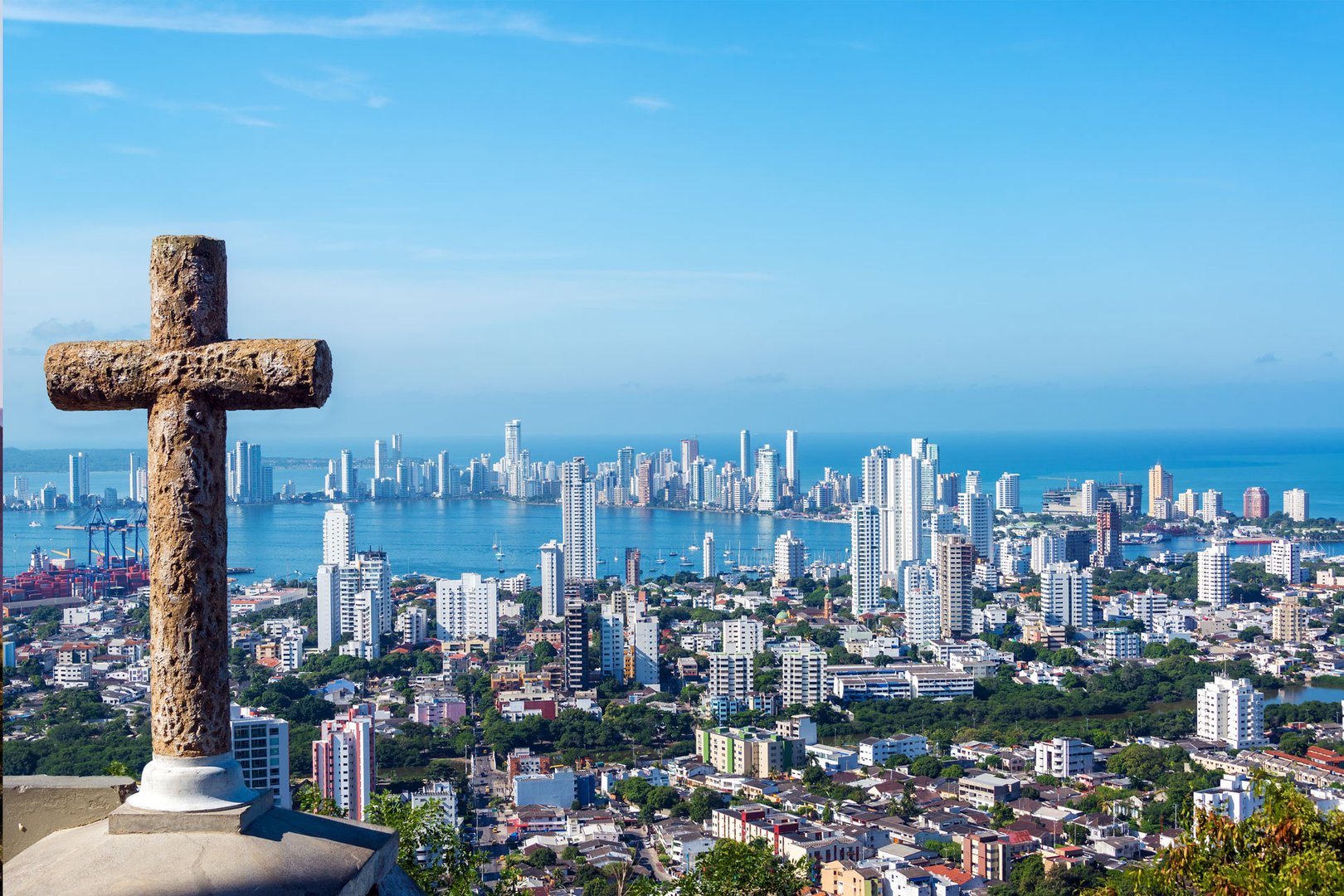
Aerial view of Stone Cross and Cartagena, Colombia on a JetBlue Vacations Flight + Hotel all inclusive package

Bocagrande

Cartagena's modern beachfront peninsula is where the major hotel brands are, along with the city's only in-town beach and a long strip of seafood restaurants along Carrera 1. The beach is serviceable rather than spectacular - the best sand and water require a boat ride - but Bocagrande suits families and those who want resort amenities close at hand.

Best for: Families, guests at large hotel brands, travelers who want beach walkability.

Manga

A quieter residential island connected by bridge, sitting between Bocagrande and the Old City, Manga has been quietly attracting some of Cartagena's best new restaurants along with a handful of boutique hotels. The waterfront views back toward the Walled City are among the finest in town.

Best for: Return visitors, foodies, travelers looking for a calmer pace.

Getsemaní

Just outside the walls, Getsemaní is a historically Afro-Colombian neighborhood that has become one of Colombia's most interesting creative districts without losing its character. The Plaza de la Trinidad fills every evening with locals and travelers, and the murals, bars, and restaurants make it the most authentic part of the city.

Best for: Travelers seeking local authenticity, solo travelers, nightlife seekers, budget-conscious visitors.

Getting there & around

Getting to Cartagena:

Cartagena is served by Rafael Núñez International Airport (CTG), located on the edge of the Bocagrande/Marbella area, approximately 15-20 minutes from the Old City by taxi.

From the airport:

Taxi: The standard and most reliable option. Negotiate the fare before getting in; airport taxis to the Old City or Bocagrande typically run COP 20,000-35,000 (approximately $5-9 USD). Avoid unofficial drivers approaching in the arrivals hall; use the official taxi queue.

Rideshare (InDriver/Uber): Both InDriver and Uber operate in Cartagena, though availability from CTG can be inconsistent. If you can connect to airport Wi-Fi before exiting, requesting a rideshare before clearing arrivals often works well.

Pre-booked private transfer: Recommended if you have luggage and want a fixed price with no negotiation.

Rental car: Not recommended for most visitors. The Old City is pedestrian-only, parking is extremely difficult, and most of Cartagena's attractions are accessible by taxi or on foot.

Getting around:

Taxi: The primary mode of transport between neighborhoods. Taxis are metered in theory but drivers often quote flat rates - agree on a price before you go. COP 8,000-15,000 covers most trips within the city.

InDrive / Uber: InDrive is the more reliable option - it's widely used throughout Colombia and typically offers lower prices than hailed taxis. Uber's availability in Cartagena is subject to change given its ongoing regulatory status in Colombia; confirm before relying on it.

Walking: The Old City and Getsemaní are best explored entirely on foot. Most of what you want to see and do in the historic core is within a 20-minute walk.

Golf carts: Available for rent by the hour in the Old City and occasionally in Bocagrande - a fun way to cover more ground, particularly along the walls.

Boat taxis: For getting to the Rosario Islands or Playa Barú, the main departure point is the Muelle Turístico; day-trip boats typically depart between 8-9am. Book through your hotel or a local operator the day before.

Tip for transportation: For any trip involving the Old City, staying inside the walls (or within a 10-minute walk in Getsemaní) is the single best transportation decision you can make. Almost everything you'll want to do is walkable, and eliminating the need for constant taxis dramatically improves the experience.

Best time to visit Cartagena

Cartagena sits close to the equator and maintains warm temperatures year-round - the real variable is rainfall and humidity, which divides the year into dry and wet seasons. Unlike many Caribbean destinations, Cartagena's appeal is not primarily beach-driven, which means the wet season has less impact on the overall experience than you might expect.

  • December through April - dry season: This is peak season, and for good reason. Temperatures sit in the mid-80s°F (28-30°C) with lower humidity and little to no rain. The sky is reliably clear, the Rosario Islands day trips are at their best, and the city is lively with both local and international visitors. Expect higher hotel prices and lower room availability, particularly around Christmas, New Year's, and Carnival (February). Book well in advance for January-March travel.
  • May through July - shoulder season: The transition into the rainy season brings afternoon showers, often brief and intense rather than all-day rain. Humidity rises but temperatures stay consistent. Hotel prices drop meaningfully, crowds thin, and the city remains fully operational. This is a good window for travelers who prioritize value and don't mind occasional afternoon rain.
  • August through November - wet season: Rain increases, particularly in September and October, and the Caribbean can feel more overcast and sticky than the dry season. Cartagena doesn't fall under the same hurricane risk as the island Caribbean, but seas can be rougher and boat trips to the Rosario Islands less appealing. That said, this is when Cartagena is at its most authentically local - fewer tourists, more reasonable prices, and the city's cultural calendar continues at full speed.

Monthly guide

Best for beach time: December-April, when the Rosario Islands and Playa Barú are at their clear-water best.
Best for budget travel: September-November, when hotel rates drop and the city is less crowded - though be prepared for more rain.
Best for festivals: February (Cartagena International Music Festival, Carnival), March (Cartagena International Film Festival - FICCI, one of Latin America's oldest), November (Cartagena International Book Fair - Hay Festival Cartagena).
Best for avoiding crowds: May-June, which offers the dry season's tail end with meaningfully lower prices and thinner tourist numbers.

Your day-by-day guide:

4-day Cartagena itinerary

Day 1: Arrival and Old City first impressions
After landing at CTG and the short taxi ride to your hotel, drop your bags and step outside - the Old City is best understood by wandering first, orienting later. Spend the afternoon walking Las Murallas, the great defensive walls that circle the Walled City, and work your way in toward the Plaza de Bolívar and the Cathedral Basílica de Santa Catalina de Alejandría, whose golden facade glows in the afternoon light. Pick up a fresh jugo de corozo - the deep purple local drink made from a Caribbean berry - from a street vendor. As the temperature drops in the early evening, find a rooftop bar above the walls - the view over the Caribbean at sunset is one of those travel moments that justifies the whole trip. End the evening at one of the Old City's courtyard restaurants; try Alma or Carmen for Colombian cuisine at its most elevated, or follow the sound of vallenato music to something less formal.

Day 2: Deep dive into history and Getsemaní nights
Begin the morning at Castillo San Felipe de Barajas, the massive hilltop fortress built by the Spanish in the 17th century and one of the finest examples of military architecture in the Americas. The tunnels beneath the castle are open for exploration and genuinely impressive. From there, cross back into the city and visit the Palacio de la Inquisición - the former seat of the Spanish Inquisition in New Granada - whose museum is sobering, well-curated, and rarely crowded. Spend the afternoon at your hotel pool or back on the walls with a book, then walk fifteen minutes to Getsemaní as the sun goes down. The neighborhood's street art reveals itself best in the golden hour. Settle into the Plaza de la Trinidad for a beer and the slow, easy rhythm of a Getsemaní evening; the square fills organically as the night deepens, and from there the bars and music spill into the surrounding streets.


Day 3: Rosario Islands day trip
Set an early alarm and be at the Muelle Turístico dock by 8am for the speedboat to the Rosario Islands and Playa Barú. The 45-minute ride across bright Caribbean water is part of the experience. Spend the morning snorkeling above the coral reefs of the Rosario archipelago - visibility is often exceptional, and the sea life is genuinely abundant - before the boat moves on to Playa Blanca on Barú for the afternoon. The beach lives up to its name: a long, wide crescent of white sand with warm, clear water and a handful of casual restaurant palapas serving grilled fish and cold beer. Stay as long as you can justify and catch the late-afternoon return boat back to the city. That evening, keep it simple - ceviche and a cold Águila at one of Getsemaní's neighborhood spots, then an early bed after a long day in the sun.

Day 4: Neighborhood wandering and departure
Use the final morning to see what the itinerary hasn't covered: the emerald shops on Calle Gastelbondo, the Museo del Oro Zenú (small but exceptional, covering the pre-Columbian gold traditions of the region), or simply another long coffee and pastry at a Walled City café while the city wakes up. If your flight is in the afternoon or evening, Bocagrande offers a low-effort final morning - beach chairs, a seafood lunch, and a straight shot to the airport. Transfer to CTG sun-warmed and thoroughly convinced that Cartagena deserves a return visit.

Accommodations options

Cartagena's lodging landscape is unusually varied for its size, ranging from world-class boutique hotels in restored colonial mansions to affordable guesthouses in Getsemaní and high-rise chain hotels in Bocagrande. The Walled City commands a price premium - often a significant one - but offers an experience that's hard to replicate: staying inside a UNESCO World Heritage site, within walking distance of almost everything, in some of the most beautiful buildings in Latin America. Note that Cartagena does not have a strong all-inclusive tradition; the all-inclusive format is largely absent from the Old City and Getsemaní, and even in Bocagrande it's limited. The lodging model here is more European - independent boutique properties, often with excellent in-house restaurants, that reward exploration of the broader city rather than staying on property.

Types of properties:

  • Boutique heritage hotels (Old City): The highest concentration of remarkable properties in Colombia. Colonial mansions converted into 10-30 room hotels with courtyard pools, rooftop terraces, and individual room designs. Examples include Casa San Agustín, Bastión Luxury Hotel, and Hotel Quadrifolio. These properties define Cartagena for most travelers who stay in them.
  • Guesthouses and posadas (Getsemaní): A growing category of small, independent properties - often in restored older buildings - that offer real value and local character. Quality varies; look for properties with strong recent reviews. The best combine affordability with design sensibility and excellent location.
  • Large hotels and resorts (Bocagrande): The major international brands - Hilton, Marriott, Hyatt - are concentrated here. These offer pools, direct beach access, and familiar amenities at prices somewhat lower than comparable Old City boutiques. Best for families or those who want resort infrastructure alongside the city experience.
  • Apartment rentals (citywide): Particularly useful for longer stays or groups. Old City apartments and Bocagrande beach apartments both have active rental markets and can significantly undercut hotel prices per person for groups.
  • Eco-lodges and island stays (Rosario Islands): For travelers who want to wake up on the water, a handful of eco-lodges on the Rosario Islands offer overnight stays - rustic by definition but extraordinary in setting. Logistics require planning through a local operator..

Price ranges:

  • Budget ($60-120/night): Guesthouses and posadas in Getsemaní; some older hotels in Bocagrande. Functional, often with more character than the price suggests.
  • Mid-range ($150-300/night): Solid boutique hotels in the Old City; better Bocagrande options with pools. This range represents strong value for Cartagena - the gap between mid-range and budget here is noticeable.
  • Luxury ($350-900+/night): The Old City's top heritage hotels, offering a genuine luxury experience with architecture and service that can compare favorably to any boutique hotel in the Caribbean.

Special considerations:

  • Colombia charges a 19% VAT that applies to most hotel stays; some properties include this in quoted rates, others don't - confirm before booking.
  • Peak season (December-March, Semana Santa, Carnavales) sees significant price spikes and availability crunches; Old City properties can sell out months in advance for Christmas and New Year's.
  • The Old City has no on-site parking and very limited nearby parking; car rental is not recommended for guests staying here.
  • Air conditioning is standard and necessary - Cartagena's climate makes it non-negotiable, particularly during the wet season.
  • Some older boutique properties in the Old City have rooms without windows or very limited natural light (a product of colonial building design); check room descriptions carefully before booking.

Booking tips:

  • For Old City boutique hotels, booking 3-4 months in advance is advisable for December-March travel; last-minute availability at reasonable prices is rare.
  • A JetBlue Vacations bundle often provides meaningful savings on Old City hotels that are otherwise sold at full rate; the flights + hotel package can outperform booking separately.
  • For shoulder-season travel (May-July), same-week booking at strong properties is sometimes possible at rates 30-40% below peak.
  • If the Old City is sold out or out of budget, Getsemaní is a better base than Bocagrande for first-time visitors who prioritize the cultural experience.

Top attractions & activities

Playa Blanca, Barú

A 45-minute speedboat ride from the city, Playa Blanca is a long crescent of fine white sand with warm, clear Caribbean water. The beach is backed by simple palapa restaurants serving grilled whole fish and fresh ceviche. It's Colombia's best easily accessible beach, and the day trip format - combined with morning snorkeling in the Rosario Islands - is the classic JBV Cartagena excursion.

Rosario Islands snorkeling

The coral reefs of the Islas del Rosario National Natural Park host abundant marine life in unusually clear water. Many day-trip boats include snorkeling equipment; visibility conditions are best December through April. The archipelago also has a small aquarium and several island stops depending on your operator.

Las Murallas (The City Walls)

Walking the full perimeter of Cartagena's defensive walls takes about 45 minutes and offers some of the finest urban views in the Caribbean - the Old City on one side, the Caribbean Sea on the other. Best at dawn or in the hour before sunset. The walls are always open and free to walk.

Castillo San Felipe de Barajas

Cartagena's most impressive fortification - a massive hilltop castle built and expanded between 1536 and 1657 - is one of the best-preserved examples of Spanish colonial military architecture anywhere in the Americas. The network of tunnels beneath the fort is genuinely extraordinary and open for self-guided exploration.

Food, drink & entertainment:

  • Old City rooftop bars: Cartagena has a remarkable concentration of rooftop bars within the Walled City, many situated on top of buildings that allow views over the colonial roofscape toward the sea. Albarco, El Coro at Sofitel Legend Santa Clara, and the rooftop at Bastión are among the most celebrated; sunset hours are reliably spectacular.
  • Getsemaní nightlife: The Plaza de la Trinidad fills organically every evening with locals and visitors - street vendors circulate with beer and arepas, groups spill in and out of the surrounding bars, and occasional live music surfaces without announcement. The informal outdoor scene transitions into more structured bars and clubs as the night deepens.
  • Cartagena's fine dining scene: In the last decade, a generation of Colombian chefs has brought the country's food culture into international conversation, and Cartagena is part of that story. Restaurants like Celele, La Cevichería, and El Gobernador work seriously with Caribbean coastal ingredients and cooking traditions. Price points remain accessible by international standards.

Historical & cultural sites:

  • Palacio de la Inquisición: The former seat of the Spanish Inquisition in New Granada, located on the Plaza de Bolívar. The museum now occupying the building covers the history of the Inquisition in Colombia with unusual clarity and directness - the instruments displayed are not for the faint of heart, but the historical context is essential. One of the best museums in the city.
  • Museo del Oro Zenú: A small but beautifully curated museum covering the pre-Columbian gold and ceramic traditions of the Zenú people, who inhabited this region of the Caribbean coast for centuries before the Spanish arrival. Free to enter; rarely crowded; a 30-minute visit that adds significant depth to the day.
  • Cathedral Basílica de Santa Catalina de Alejandría: The oldest cathedral in Colombia, begun in 1575 and completed over the following century. The golden exterior is iconic on the Plaza de Bolívar; the interior is more austere but contains several centuries of history. Open to visitors during non-service hours.
  • Getsemaní murals: The neighborhood-wide street art project that has transformed Getsemaní over the past decade is best explored on foot without a map. The density and quality of the murals - ranging from political commentary to Afro-Colombian cultural portraiture - is exceptional, and new works appear regularly.

Standout experience: Sunset on the Walls

Walking Las Murallas at sunset is the defining Cartagena experience - and one of the most beautiful things you can do in the Americas for free. In the hour before the sun hits the water, the light turns gold, the Caribbean shifts from blue to copper, and the city rises behind you: clock tower, cathedral bell tower, colonial rooflines draped in bougainvillea. Street vendors circulate with coconut and cold drinks; couples settle into the notched openings in the wall. By the time the sun actually sets, a small crowd gathers without planning to, and for a moment everyone goes quiet.

Local culture

Cartagena is a vibrant blend of Caribbean, Afro-Colombian, and Spanish colonial identities. For four centuries, the Afro-Colombian community has shaped the city’s music and cuisine, while the Spanish legacy defines its architecture. This cultural depth—visible in every stone and modern art scene—makes a multi-day stay essential for travelers seeking a rich, meaningful Colombian experience.

  • Greetings are warm and physical
  • Haggling is appropriate in markets, not restaurants
  • Photography of people requires permissio
  • Tipping is customary but not automatic
  • Night starts late

Culture site etiquette:

  • Churches and cathedrals: Modest dress is required - shoulders and knees covered. Many churches are active places of worship; visitors are welcome but should observe quietly during services and silence phones.
  • Castillo San Felipe: Photography is unrestricted and encouraged. The tunnels beneath the fort are open but can be dark - a phone flashlight is useful.
  • Palacio de la Inquisición: The museum asks that visitors not photograph the more graphic torture implements on display; the rest of the museum is photo-friendly.
  • Palenque de San Basilio: If you visit this community, do so through a reputable cultural operator who has relationships with the community and can ensure your visit is structured respectfully. Independent arrival is generally not appropriate.

Appropriate dress:

  • In the Old City: Casual but presentable. The neighborhood is walkable in shorts and a light shirt, but restaurants at the upper end of the market tend toward smart casual in the evenings.
  • At churches and historic sites: Shoulders and knees covered - a light scarf or sarong in your bag solves the problem easily.
  • On Rosario Islands / Playa Barú: Swimwear is appropriate from boat to beach and back. Bring a cover-up for the return trip and any restaurant stops.
  • In Getsemaní: The neighborhood is relaxed; dress is casual. For nightlife, the dress code is more spirited - Cartageneros put visible effort into how they dress for a night out, and matching that energy is appreciated.

Local festivals:

  • Carnavales de Cartagena (November 11): The city's independence anniversary is celebrated with parades, music, and a city-wide party that brings Cartagena's Afro-Caribbean traditions to the streets. One of Colombia's most energetic civic celebrations.
  • Festival Internacional de Música de Cartagena (January): An internationally recognized classical and chamber music festival held across Old City venues, including the Teatro Heredia. Unusual for a Caribbean city of this size, and remarkable for the quality of artists it attracts.
  • FICCI - Festival Internacional de Cine de Cartagena (March): One of Latin America's oldest film festivals, held since 1960. Screenings take place in Old City plazas and theaters; the festival has a strong Latin American and Caribbean program.
  • Hay Festival Cartagena (January/February): The Colombian edition of the renowned Hay literary festival - four days of writers, thinkers, and public conversations in Old City venues. One of the most intellectually vibrant events in the region.
  • Semana Santa (April - Holy Week): As in much of Latin America, Holy Week is observed with solemnity and processions throughout the city. It's also the high season for domestic tourism - book accommodation well in advance.

Dining Guide

Local specialties

Cartagena’s underestimated food scene is a must-visit, blending African, Indigenous, and Spanish traditions. From $2 street snacks to world-class tasting menus, enjoy fresh ceviche, coconut stews, and fried fish. This vibrant coastal Colombian cuisine offers high-end dining at a better value than most Caribbean destinations.

Must try dishes:

  • Arepa de huevo: The defining Cartagena street food - a corn arepa deep-fried, slit open, filled with a raw egg and then fried again until the egg is cooked inside the arepa. Crispy, warm, utterly satisfying, and available from street vendors throughout the Old City and Getsemaní for around $1. Best eaten standing on a corner.
  • Ceviche de camarón: Cartagena's shrimp ceviche is made with fresh Caribbean shrimp, lime juice, cilantro, and a slightly sweet tomato-based leche de tigre that differentiates it from Peruvian versions. La Cevichería on Calle Stuart is the most famous address for this dish, but versions appear across the city at every price point.
  • Cazuela de mariscos: A rich, coconut milk-based seafood stew containing a combination of local fish, shrimp, squid, and shellfish, thickened with hogao (a Colombian tomato-onion sauce) and served with white rice and patacones (fried plantains). The definitive Cartagena comfort food.
  • Patacones: Double-fried green plantains, pressed flat and crisped - ubiquitous as an appetizer, side dish, and base for toppings ranging from guacamole to seafood. Excellent at virtually every level of restaurant.
  • Coctel de camarones (shrimp cocktail): Not the gringo version - here it's chilled poached shrimp in a cold sauce of tomato, lime, and hot pepper, served in a tall glass with crackers. A classic Old City appetizer and one of the great simple pleasures of a Cartagena afternoon.
  • Enyucado: A traditional sweet made from grated yuca, coconut, anise, and cheese - dense, slightly sticky, and unusual in flavor in a way that's hard to describe until you've had one. Found at local markets and some traditional restaurants; an authentic taste of the coastal cuisine.

Dining price ranges

  • Budget ($3-12 per meal): Street food (arepas de huevo, patacones, fresh fruit), neighborhood fondas, and casual seafood spots in Getsemaní and the local market. Excellent value and often excellent quality.
  • Mid-range ($15-35 per meal): The broad middle of the Old City and Getsemaní restaurant market - good seafood restaurants, traditional Colombian cooking, international options. This tier offers the city's best value.
  • Upscale ($45-100+ per meal): The tasting-menu restaurants drawing on regional ingredients and technique: Celele, El Gobernador, Carmen. Comparable to high-end dining in European or U.S. cities at roughly half the price.

Popular restaurants in the area

  • Old City streets (Calle del Colegio, Calle Gastelbondo, Calle Santo Domingo): The highest concentration of upscale restaurants, rooftop bars, and courtyard dining in the city. Expect to pay Old City prices; the quality is generally worth it.
  • Plaza de la Trinidad, Getsemaní: The neighborhood around the plaza has a string of affordable, local restaurants and bars. The quality is uneven but the best spots - found by walking and looking at what locals are eating - are excellent.
  • Bocagrande beachfront (Carrera 1): A long strip of casual seafood restaurants facing the water. Not the city's most interesting dining, but reliable for fresh fish, good value, and easy beach-adjacent convenience.

Dietary restrictions

Vegetarians and pescatarians are reasonably well served in Cartagena - seafood is central to the cuisine, and most restaurants offer several non-meat options. Vegans will find more limited choices outside the Old City's international restaurants, though the abundance of fresh tropical fruit, rice dishes, and bean-based sides makes subsisting well possible. The city's better restaurants are increasingly attentive to dietary requests; communication in Spanish is helpful, though most Old City staff at mid-range and upscale venues speak some English.

Travel tips & requirements


Tourists walking in La Fortaleza

Packing tips

Essential items:

  • Lightweight, breathable clothing - linen and moisture-wicking fabrics in neutral or light colors.
  • Good walking sandals for cobblestone streets (the Old City is uneven; heels are ill-advised).
  • Comfortable closed-toe shoes or sneakers for the castle, tunnel walks, and long evenings.
  • Light layers for air-conditioned restaurants and hotels (interiors can be aggressively cold).
  • High-SPF sunscreen and a hat - the Caribbean sun is intense even in the dry season.
  • A small crossbody bag or daypack - leave large bags at the hotel for street wandering.
  • A sarong or light scarf (serves as beach cover-up, church-entry covering, and extra layer.
  • Swimwear (at least two sets - things dry slowly in humid weather).
  • Waterproof sandals or flip-flops for boat trips and beach days.

Unexpected necessities:

  • A power bank - Cartagena's street-exploring sessions run long, and your phone will die finding your way back from Getsemaní at midnight.
  • Insect repellent - mosquitoes are not a major problem in the Old City but become more relevant at Playa Barú and outside town.
  • Cash in Colombian pesos - while cards work at Old City restaurants and hotels, street vendors, local fondas, the boat dock, and beach vendors operate cash-only; ATMs in the Old City are available but sometimes have queues.
  • Reef-safe sunscreen - the Rosario Islands are a national park; standard sunscreen is damaging to the coral.
  • A dry bag - essential for speedboat trips to the islands, where spray is unavoidable.
  • Anti-diarrheal medication - not that it's likely needed, but the transition to local food and water can catch travelers off guard; avoid tap water and stick to bottled.

Protect your trip with Allianz

​Traveling to Cartagena is an exciting adventure, get coverage for unforeseen events such as trip cancellations, medical emergencies, and lost baggage. With Allianz's 24/7 assistance, you can explore Cartagena with confidence, knowing that support is just a phone call away.

​Protect your trip with Allianz

Entry requirements

U.S. citizens do not need a visa to enter Colombia for tourism stays of up to 90 days. A valid U.S. passport is required - ensure it has at least six months of validity beyond your travel dates and at least one blank page for the entry stamp. Colombian immigration officers routinely ask for proof of onward travel (a return or connecting flight booking); have your return ticket accessible at the immigration counter. A Tourist Card (Tarjeta de Turismo) is sometimes required and may be distributed on the flight or collected on arrival - the fee is approximately $16 USD, payable by card at the airport.

Non-U.S. citizens should verify visa and entry requirements with the Colombian consulate or embassy in their country of residence well in advance of travel; requirements vary significantly by nationality.

Language and communication

Spanish is Colombia's national language, and Cartagena is no exception - Cartagenero Spanish has a distinctive Caribbean cadence that sets it apart from the Bogotá standard. In the Old City's tourist corridor, English is available at most hotels, upscale restaurants, and tour operators; outside those environments - in Getsemaní, at the boat docks, in local markets - Spanish is necessary. A few basic phrases and numbers go a long way and are received warmly. Colombians are generally patient and enthusiastic with foreign Spanish speakers; the culture rewards the attempt.

Currency and money

Colombia's currency is the Colombian peso (COP). As of early 2026, the exchange rate hovers around COP 4,000-4,200 per USD, though this fluctuates - check current rates before travel. Unlike some Caribbean destinations, U.S. dollars are not widely accepted as a walk-in currency in Cartagena; some tourist-facing businesses and hotels will exchange or accept them, but you should not rely on this. ATMs are widely available throughout the Old City, Getsemaní, and Bocagrande; most accept foreign cards (Visa and Mastercard are most reliable) but charge local withdrawal fees. Withdrawing a larger amount in one transaction minimizes fees. Credit cards are accepted at most Old City restaurants and hotels; street vendors and local markets are cash-only.

Tipping customs mirror U.S. norms:

  • Restaurants: Most add a voluntary 10% ‘propina’ to the bill; pay it for good service.
  • Bars and street vendors: Rounding up is customary; not expected.
  • Hotel housekeeping: COP 5,000-10,000 (approximately $1.25-2.50) per night is appreciated.
  • Tour guides: COP 20,000-40,000 ($5-10) for a half-day tour; COP 50,000+ for full-day excursions.
  • Taxi drivers: Not customary unless they've helped significantly with luggage; rounding up is fine.

Technology resources

Power & electricity: Colombia uses Type A and B outlets (the same flat two- and three-prong standard as the United States) at 110 volts. U.S. travelers do not need adapters or converters.

Mobile service: U.S. carriers including T-Mobile and AT&T offer international roaming in Colombia, typically at an additional daily charge. Coverage in Cartagena's urban core and Bocagrande is excellent (4G/LTE); in the Rosario Islands, service is limited. A local Colombian SIM from Claro or Movistar is available cheaply at the airport and around the Old City for travelers on extended stays.

Wi-Fi accessibility: Hotels across all categories offer reliable Wi-Fi; Old City restaurants typically provide it as well. Coverage in Getsemaní and at street level can be inconsistent; plan to rely on mobile data for navigation.

Useful apps:

  • InDrive / Uber: Both work well in Cartagena for reliable, fixed-price rides. Essential for late-night returns or inter-neighborhood trips with luggage.
  • Google Translate: The camera-based translation feature is useful in markets and menus; download the Spanish language pack for offline use.
  • WhatsApp: The universal Colombian communication platform - hotels, tour operators, and local contacts all use it; essential for coordinating boat trips, restaurant reservations, and day-trip logistics.

Health & safety

Cartagena is one of the safer major cities in Colombia for tourists - the Old City in particular has a significant security presence and very low rates of serious crime. The most common issues are pickpocketing in crowded areas and overcharging by unofficial vendors or taxis; both are manageable with basic attention. Getsemaní is generally safe in the evening hours along main streets but warrants more caution on quieter blocks late at night. Exercise standard urban precautions: don't display expensive jewelry or electronics conspicuously, keep phones secure in crowded markets, and use InDriver or Uber for late-night rides rather than hailing taxis from the street in unfamiliar areas.

Safety tips

  • Use hotel safe storage for passports and excess cash; carry a photo of your passport rather than the original when sightseeing.
  • Drink bottled water only - tap water is not reliably potable.
  • Apply insect repellent before boat trips and any time you're outside the main urban core after dark.
  • Book day trips and tour operators through your hotel or a reputable local agency rather than from unsolicited street approaches.
  • Maintain awareness in the market areas (Mercado de Bazurto) - these are local markets with little tourist infrastructure and require more alertness than the Old City.
  • Travel insurance with medical evacuation coverage is strongly recommended.

Medical facilities

Cartagena has a private hospital network (Clínica Boca Grande, Clínica Universitaria San Juan de Dios) capable of handling most emergencies; serious cases may require transfer to Bogotá. Emergency numbers: 123 (Colombia emergency services), 112 (general emergency).